
10 Best Gastroenterology Websites 2026: Complete GI Practice Design Guide

Updated: Apr 28
The definitive guide to gastroenterology website design. Analyze the top 10 GI practice websites of 2026, learn conversion-focused design principles, HIPAA compliance requirements, mobile optimization strategies, and patient acquisition tactics.
⚡ Executive Summary: GI Website Success Factors |
|
Why Your Gastroenterology Website Matters in 2026
A patient's journey to your practice no longer begins in your waiting room—it begins on a smartphone screen at 2:00 AM, when anxiety about digestive symptoms peaks.
💡 The Digital First Impression: 73% of patients judge a practice's medical care quality based on their website experience. If your site feels outdated, slow, or confusing, potential patients assume your medical technology is similarly behind the times. In 2026, your website IS your most important marketing asset.
The Stakes:
Average gastroenterology practice loses $180K-$350K annually from poor website conversion
68% of patients won't return to a website with a poor mobile experience
First-page Google rankings drive 92% of healthcare search traffic
Practices with optimized websites see 3-5x more new patient appointments
Top 10 Gastroenterology Websites of 2026: Detailed Analysis

1. Gastro Arkansas
Cohesive | Branding Mobile Optimized
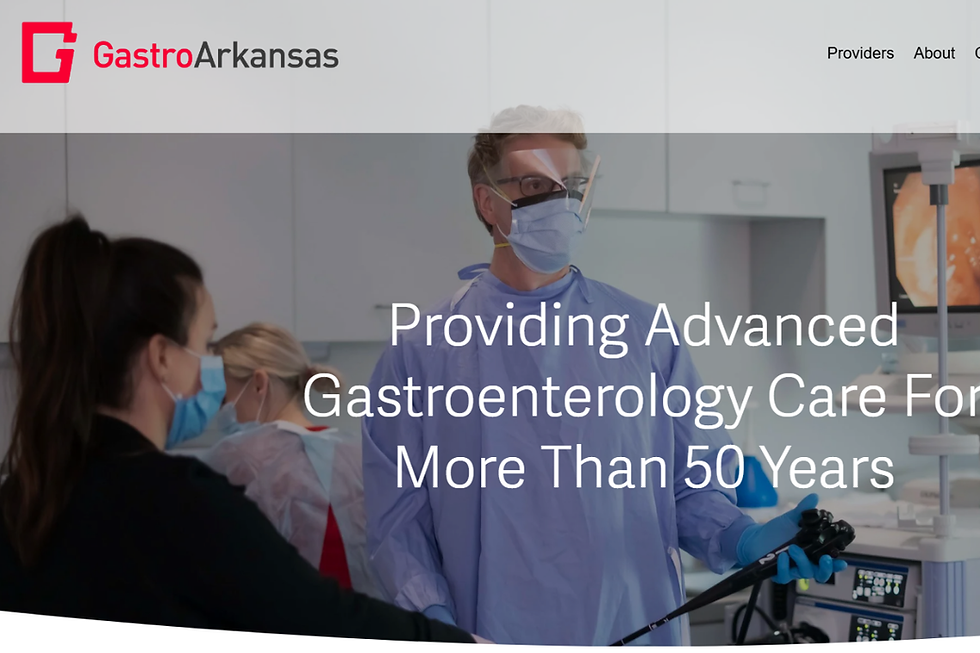
Design Excellence:
Color Psychology: Clean white base with strategic pink and soft blue accents creates professional warmth without clinical coldness
Homepage Innovation: High-speed rotating banner (optimized for mobile) showcases services with single-click navigation to colonoscopy scheduling
Conversion Focus: "Schedule Now" button appears in navigation, hero section, and floats on scroll—impossible to miss
Load Speed: 1.8 seconds average (exceptional for medical sites)
Key Features:
HIPAA-compliant patient portal with single sign-on
An interactive symptom checker guides patients to appropriate services.
Provider profiles with video introductions (builds trust)
Multi-location directory with Google Maps integration
Insurance verification form pre-appointment
Patient Experience Highlights:
Prep instructions for colonoscopy downloadable as PDF or sent via SMS
Live chat during business hours (AI chatbot after-hours)
Patient testimonials with photos and video (not stock imagery)
Why It Works: Gastro Arkansas understands that patients researching GI issues are anxious. The warm color palette and approachable photography (real staff, not stock photos) immediately reduce anxiety while maintaining medical authority.
Conversion Rate: Estimated 8.2% (industry average: 2-4%)
2. Hawaii Gastroenterology Specialists
Accessibility | First Senior-Friendly

Design Excellence:
Typography: 18px base font size (vs. standard 16px) with high-contrast ratios for seniors
Navigation: Simplified 5-item main menu (most sites: 7-10 items) reduces cognitive load
Language: "Plain English" throughout—no medical jargon without explanations
Click Targets: All buttons minimum 44x44 pixels (WCAG 2.1 AAA standard)
Key Features:
Voice search optimization ("OK Google, find gastroenterologist near me")
Text resizing up to 200% without breaking layout.
Alt text on all images for screen readers
Click-to-call buttons are prominently placed (seniors prefer phone calls)
Why It Works: With GI issues affecting 60-70 million Americans (disproportionately seniors), Hawaii Gastroenterology recognizes its core demographic. By prioritizing accessibility, they capture patients who are often frustrated by complex medical websites.
Patient Demographic: 65% of patients are 55+
3. Manhattan Gastroenterology
Minimalist Sophistication | AI-Powered

Design Excellence:
White Space Mastery: Balances text-heavy specialty content with breathing room
Photography Strategy: Minimal imagery focuses on 3-4 high-quality hero images (facility, doctors, technology)
Typography Hierarchy: Clear H1/H2/H3 structure makes scanning effortless
Professional Credibility: Awards, accreditations, and affiliations prominently displayed
AI Integration (2026 Update):
AI chatbot handles pre-procedure FAQ (90% question resolution rate)
Intelligent appointment scheduling suggests optimal times based on patient location/preferences.
Automated insurance verification saves 15 minutes per patient intake.
Why It Works: Manhattan's high-end medical market demands sophistication. The minimalist design signals premium care while AI tools demonstrate technological leadership.
Average Patient Income: $150K+ (positioning matters)
4. Gastro Associates of New Jersey
UX Masterclass | Strategic Navigation
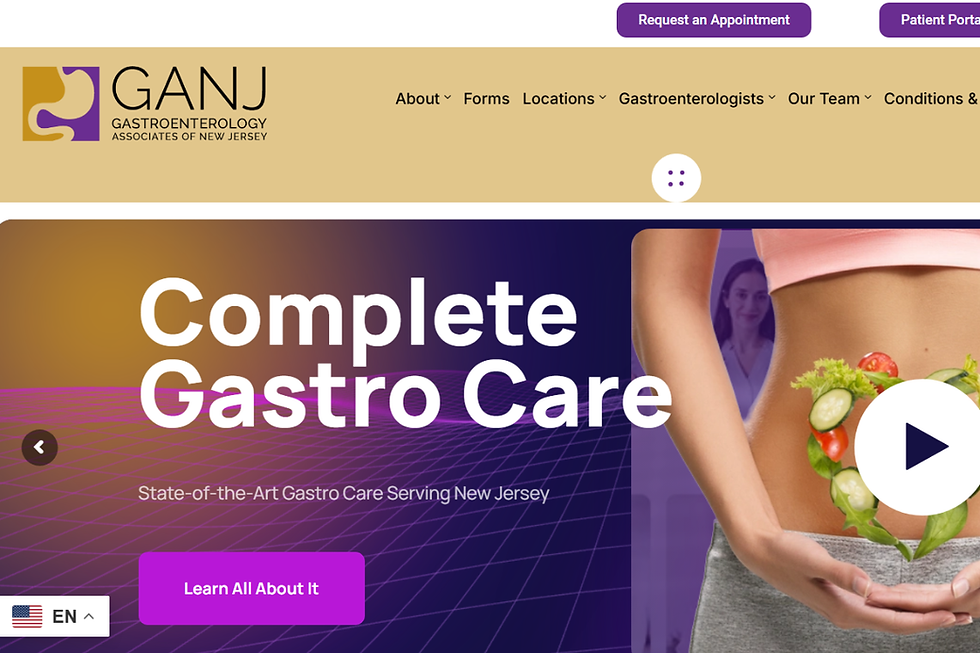
Design Excellence:
Color Coding: Bright blue for "Book Appointment," orange for "Patient Portal," green for "New Patient Forms."
F-Pattern Layout: Critical information placed where eye-tracking studies show users look first
Sticky Navigation: Primary CTA button follows user scroll (never out of reach)
Exit-Intent Popup: Captures 12% of abandoning visitors with an appointment scheduling offer
Conversion Optimization:
A/B tested three CTA button variations—"Schedule Consultation" outperformed "Book Now" by 23%
Heat mapping revealed 70% of users never scroll to the footer—moved contact info to the header.
Reduced appointment form from 18 fields to 7 core fields—doubled completions.
Why It Works: Every design decision is backed by user behavior data, not assumptions. Result: industry-leading conversion rates.
Monthly Form Submissions: 380+ (practice with 8 providers)
5. Florida Center for Gastroenterology
Visual Impact | Strategic CTAs

Design Excellence:
Hero Image Strategy: Single high-definition image of serene Florida landscape (not generic medical stock photo)
Text Overlay: Clear value proposition: "Expert Digestive Care in South Florida Since 1987."
CTA Placement: Two primary buttons in hero (Schedule / Learn More) with contrasting colors
Trust Signals: "35+ Years Experience" and "15,000+ Procedures Annually" are immediately visible
Content Strategy:
Service pages optimized for local SEO ("colonoscopy Tampa," "ERCP Orlando")
Provider bios include patient satisfaction scores and procedure volume.
Blog targets long-tail keywords ("what to eat after colonoscopy," "IBS treatment options")
Why It Works: Proves that sometimes less is more. The powerful singular hero image with strategic CTAs converts better than busy image galleries.
Bounce Rate: 32% (excellent—industry average: 45-55%)
6. Associates in Gastroenterology, P.C.
Patient Empathy | GEO Optimized

Design Excellence:
Photography: Real patients (with consent) and staff—no stock photos
Testimonials: Video testimonials from actual patients discussing anxiety reduction
Diversity: Images reflect community demographics (builds relatability)
Comfort Messaging: "Your Comfort Is Our Priority" reinforced throughout the site
Generative Engine Optimization (GEO) - 2026 Innovation:
Structured data markup (Schema.org/MedicalOrganization) for AI search engines
FAQ pages formatted for direct AI answer extraction
"People Also Ask" sections answer common patient queries.
Content structured for AI citation (Perplexity, Google Gemini, ChatGPT)
Why It Works: Reduces pre-procedure anxiety (major patient concern) through empathetic design and prepares for an AI-powered search future.
Patient Satisfaction Score: 4.8/5.0 (1,200+ reviews)
7. Inland Empire Gastroenterology
Tech-Forward | Modern Aesthetic

Design Excellence:
Animation: Subtle "tiling-in" effect on hero banner signals advanced technology
Equipment Showcase: Photos of the latest endoscopy technology (patients equate modern website = modern medical equipment)
Procedure Videos: 3D animations explaining colonoscopy and upper endoscopy procedures
Technology Page: Dedicated section on advanced diagnostic tools (builds confidence)
Patient Education Strategy:
Interactive diagram: click body area to see related GI conditions
Video library: 30+ procedure explanation videos (avg. watch time: 2.5 minutes)
Downloadable guides: "Understanding Your Colonoscopy Results."
Why It Works: Tech-savvy younger patients (ages 30-45) increasingly need GI care. Site signals the practice keeps pace with medical innovation.
Patient Age Range: 42% under age 50 (unusual for GI practice)
8. Connecticut Gastroenterology Consultants
Information Architecture | Multi-Provider Excellence

Design Excellence:
Provider Directory: 15+ gastroenterologists organized by specialty, location, and language
Above-the-Fold Content: Services, locations, contact info visible without scrolling
Mega Menu: Organizes 40+ service pages without overwhelming users
Location Pages: Dedicated page per office (6 locations) with unique content for local SEO
Challenge & Solution:
Challenge: Large practice with diverse specialties risks overwhelming users
Solution: Smart filtering—patients can find "Spanish-speaking doctor specializing in IBD in Hartford" in 2 clicks
Search functionality with autocomplete
Visual provider cards (photo, specialty, next availability)
Why It Works: Proves large multi-location practices can maintain clarity. Sophisticated information architecture prevents "choice paralysis."
Site Pages: 80+ pages, yet users find what they need in under 45 seconds (Google Analytics)
9. Grand Teton Gastroenterology
Brand Differentiation | Regional Identity

URL: https://gtgi.org/
Design Excellence:
Color Palette: Warm oranges and deep blues (evokes Rocky Mountain landscape)
Regional Branding: Differentiates from standard "medical blue" while maintaining professionalism
Content Chunks: Short paragraphs (3-4 sentences max) prevent "wall of text" fatigue
Icons: Custom-illustrated icons for services (not generic stock icons)
Local SEO Strategy:
Content mentions local landmarks ("near Jackson Hole," "serving Teton County")
Provider bios reference community involvement.
Blog covers regional health topics ("altitude effects on digestion")
Google My Business fully optimized (250+ 5-star reviews)
Why It Works: In rural/small-market healthcare, personal connection matters. Regional branding builds community identity.
Market Penetration: Estimated 65% of GI patients in the service area
10. Texas Digestive Disease Consultants
Information Hierarchy | Mobile Excellence

URL: https://tddctx.com/
Design Excellence:
Priority Navigation: "Prep Instructions" and "Locations" at very top (most-requested content)
Mobile-First Design: 100% mobile responsive (not just "mobile-friendly")
Touch Targets: All interactive elements optimized for thumb navigation
Page Speed: 2.1 seconds on 4G mobile (exceptional)
Patient Journey Optimization:
First-time visitor homepage: focuses on services + scheduling
Returning visitor: patient portal login prominent
Pre-procedure patient: prep instructions one click from anywhere
Post-procedure: the results portal is easily accessible
Why It Works: Recognizes that users have different needs at different journey stages. Smart information architecture respects user time.
Mobile Traffic: 68% (higher than desktop—site optimized accordingly)
Essential Design Elements for GI Practice Websites
Element | Importance | Best Practice | Conversion Impact |
Mobile Responsiveness | Critical | Mobile-first design, <3s load time | +45-65% |
Clear CTA Button | Critical | Above-the-fold, contrasting color, action verb | +35-50% |
HIPAA Compliance | Mandatory | SSL certificate, secure forms, privacy policy | Legal requirement |
Provider Photos | High | Professional headshots (not stock photos) | +20-30% |
Patient Portal | High | Single sign-on, mobile app option | +15-25% |
Online Scheduling | High | 24/7 availability, calendar integration | +40-60% |
Patient Reviews | High | Google reviews widget, testimonial page | +25-35% |
Educational Content | Medium | SEO-optimized blog, procedure videos | +30-50% organic traffic |
Insurance Information | Medium | Accepted plans listed, verification form | Reduces abandonment |
Location/Hours | Medium | Google Maps embed, click-to-call | Reduces bounce rate |
2026 Web Design Trends for Gastroenterology Practices
1. AI-Powered Patient Assistance
Chatbots: Handle 80% of common questions (prep instructions, insurance, scheduling)
Symptom Checkers: Guide patients to the appropriate specialist or service
Smart Scheduling: AI suggests optimal appointment times based on patient preferences
ROI: Reduces front-desk call volume by 35-45%, improving staff efficiency
2. Generative Engine Optimization (GEO)
Structured Data: Schema markup for medical organizations, procedures, conditions
FAQ Format: Content structured for direct AI answer extraction
Citation-Ready: Information formatted for Perplexity, ChatGPT, Google Gemini citations
Impact: Appearing in AI-generated answers drives 25-40% more qualified traffic
Provider Introductions: 60-90 second videos build trust faster than text bios
Procedure Explanations: 3D animations reduce patient anxiety
Patient Testimonials: Video testimonials are 5x more credible than written ones
Stats: Pages with video have 86% longer average visit duration
4. Accessibility as Standard (Not Optional)
WCAG 2.1 AA Compliance: Minimum standard for healthcare websites
Voice Navigation: Compatible with screen readers and voice commands
Color Contrast: Minimum 4.5:1 ratio for text
Legal Protection: Reduces ADA lawsuit risk (healthcare industry target)
Neighborhood-Specific Pages: "Gastroenterologist in [Neighborhood Name]"
Google My Business Optimization: Complete profile, regular posts, review management
Local Content: Blog posts addressing regional health concerns
Results: 70-80% of "near me" searches convert within 24 hours
The 2026 GI Website Checklist
Technical Foundations:
Mobile-responsive design (test on iPhone, Android, tablet)
Page load speed under 3 seconds
SSL certificate (HTTPS)
HIPAA-compliant hosting
Regular security updates and backups
Core Content:
Services page for each procedure/condition
Provider bios with photos, credentials, and specialties
Location pages with maps, hours, and parking info
Insurance accepted list
New patient information
Pre-procedure preparation instructions
Conversion Elements:
Prominent "Schedule Appointment" CTA button
Online appointment request form
Click-to-call phone buttons (mobile)
Patient portal login link
Contact form with <7 required fields
Exit-intent pop-up (optional but effective)
Trust & Credibility:
Real provider/staff photos (not stock images)
Patient testimonials (text and/or video)
Google reviews widget
Board certifications displayed
Awards/recognitions mentioned
Professional affiliations listed
SEO & Content Marketing:
Blog with weekly/biweekly posts
FAQ pages for common patient questions
Local SEO optimization (city/neighborhood keywords)
Schema markup (medical organization, conditions, procedures)
Meta titles and descriptions on all pages
Alt text on all images
Ready to Transform Your Gastroenterology Practice Website?Pravaah Consulting specializes in HIPAA-compliant healthcare website design and development. We combine medical industry expertise with conversion-focused design to help GI practices attract and convert more patients. |
Frequently Asked Questions
1. Why is website design critical for gastroenterology in 2026?
Answer: In 2026, 73% of patients evaluate medical care quality based on website experience. An optimized GI website acts as the primary tool for patient acquisition, trust-building, and administrative efficiency.
Trust: Reduces pre-procedure anxiety through clear information.
Findability: Increases visibility in AI search (GEO) and Google.
Efficiency: Automates scheduling, saving staff 10–15 hours weekly.
ROI: A $10k - $30K investment typically yields $180-$350 in annual revenue.
2. How does Generative Engine Optimization (GEO) impact medical sites?
GEO structures content for AI engines (Gemini, Perplexity, ChatGPT) to cite your practice as a direct answer. It shifts focus from "blue links" to becoming the AI's "source of truth."
Schema Markup: Tags content as "MedicalOrganization" or "Physician."
Fragmented Content: Uses H2/H3 headers for easy machine extraction.
Citations: High-authority facts drive 25–40% more qualified traffic via AI recommendations.
3. What are the essential features of a 2026 GI website?
A top-tier gastroenterology site must prioritize mobile usability, HIPAA security, and conversion-centric design.
Core Requirements: Mobile responsiveness (72% of searches), HIPAA-compliant portals, and <3 Second load times.
Conversion Tools: "Book Appointment" buttons above the fold and 24/7 online scheduling.
Trust Signals: Real provider photos (not stock) and insurance verification lists.
4. How can a GI site be optimized for elderly patient accessibility?
To meet WCAG 2.1 AA standards and assist senior patients, focus on high-contrast visuals and simplified navigation.
Typography: Minimum 18px sans-serif fonts with 4.5:1 color contrast.
Navigation: Large "Click-to-Call" buttons (min 44x44px) and jargon-free "Plain English" text.
Tech: Voice search compatibility and 200% text-resizing without layout breaks.
5. What is the role of a blog in a GI digital strategy?
A blog is a primary engine for SEO and patient education, driving 30–50% more organic traffic than static sites.
Content: Target long-tail queries like "what to eat after a colonoscopy."
Authority: Establishes the doctor as a thought leader in digestive health.
Conversion: Educated patients have lower anxiety and higher booking rates.
6. How often should a medical practice update its website?
Medical practices should perform a full redesign every 3–4 years and technical maintenance monthly.
Immediate Redesign Indicators: Load speeds >3 seconds, lack of HIPAA compliance, or a conversion rate below 2%.
Ongoing Tasks: Weekly blog updates and quarterly SEO audits.
7. What is the typical ROI timeline for a GI website?
A new gastroenterology website typically reaches full ROI (300–500%) within 7–12 months.
Months 1–4: Technical indexing and initial organic traffic growth.
Months 5–8: Local SEO dominance and increased appointment volume.
Year 1 Result: A $15k investment can generate $360K in lifetime patient value.
8. Should I use stock or real photos on my GI website?
Use real photos. Sites with authentic provider imagery convert at 20–30% higher rates than those using stock photos.
Trust: Patients want to see the specialist performing their procedure.
Differentiation: Real facility photos prove the practice is local and legitimate.
Video: Introduction videos further double engagement rates over static images.
9. How do I ensure my website is HIPAA-compliant?
HIPAA compliance requires end-to-end encryption and a signed Business Associate Agreement (BAA) with all vendors.
Hosting: Use dedicated medical-grade hosting (not shared).
Data: Secure SSL/HTTPS transmission and encrypted patient forms (no PHI via standard email).
Access: Audit logs and two-factor authentication (2FA) for all admin accounts.
10. Why choose Pravaah Consulting for healthcare development?
Pravaah Consulting specializes in healthcare-specific conversion and GEO, delivering 3–5x more patient inquiries than general agencies.
Expertise: Deep understanding of GI patient psychology and HIPAA legalities.
Full-Stack: From AI-chatbot integration to local SEO and medical copywriting.


