
10 Best Real Estate Website Designs for 2027: Interactive Property Portals and Virtual Tours

Short answer: The best real estate website designs in 2027 are Zillow, Matterport, Redfin, Compass, Rightmove, StreetEasy, Sotheby's International Realty, CREXi, realtor.com, and homes.com. They share five traits: mobile-first layouts, immersive virtual tours, fast map-based search, quick load times, and one-tap contact options.
Key takeaways |
|
It is 11 p.m. A buyer is on the couch, scrolling through homes on a phone. Within ten seconds, she decides which listings deserve a second look and which she will never think about again. Nobody called an agent. Nobody visited an open house. A website made the call.
That is the quiet truth about real estate in 2026. Your real estate website design is your first showing, your open house, and your best salesperson, all working around the clock. The sites don't just list properties. They let people walk through homes from their sofa, explore interactive floor plans, and filter by exactly what matters to them.
We reviewed leading real estate portals, platforms, and ranking articles to bring you the 10 best real estate tech and property website designs worth studying right now. For each one, you will see what it does brilliantly and the design lesson you can borrow for your own Real Estate & Property website.
What Makes the Best Real Estate Websites Stand Out?
A great real estate website design helps buyers find, judge and act on a property quickly, especially on a phone. The top sites share five ingredients:
Mobile-first design. Most property searches now start on smartphones. "Over 70% of property searches are on mobile." A clumsy mobile site loses buyers instantly.
Immersive visuals. Professional photos, 360-degree views, 3D walkthroughs, and drone footage help remote buyers feel like they are standing in the room.
Effortless search. Map view, list view, smart filters, and saved searches are now standard, not a bonus.
Speed. Pages that load in about two to three seconds keep visitors from bouncing.
Clear next steps. Book a viewing, request a callback, or message an agent should always be one tap away.
Why it matters: Zillow reports that listings with a 3D Home tour receive around 81% more online views. Other industry reports put the lift from virtual tours at up to 87%. Numbers vary by source, but the direction is clear: immersive listings get noticed.
The 10 Best Real Estate Tech & Property Website Designs
1. Zillow: best for 3D Home tours at scale

Zillow is a property-search giant, and its design shows why. Search is fast, map-driven, and packed with filters, while its 3D Home tours let agents and photographers capture a walkable tour using a smartphone camera. Zillow has also syndicated these tours to other sites, including Redfin, which widens their reach.
Standout features: 3D Home tours, interactive floor plans, saved searches, and a strong mobile app.
Design lesson: Make immersive content easy to create. When tours are simple to add, more listings have them.
2. Matterport: best for immersive 3D tours on any site
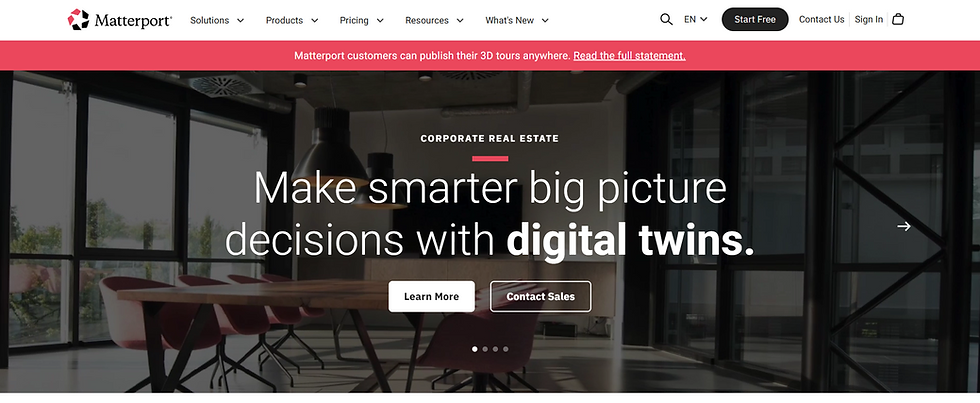
Matterport is not a listing portal, but it shapes how the best property websites feel. Its 3D tours offer a walkable model, a dollhouse view that lets buyers rotate the whole home, and support for VR headsets. Tours can be embedded on your own property website, in your CRM, and in email campaigns.
Standout features: Dollhouse view, guided tours, floor plans, and easy embedding.
Design lesson: Treat the tour as a hero element, not a link buried at the bottom of the page.
3. Redfin: best for using tours to qualify buyers

Redfin was an early mover in virtual home viewing. Its 3D Walkthrough, built with Matterport, was described at launch as being like Google Street View for the inside of a home. The idea was simple: help buyers decide which homes are worth visiting in person.
Standout features: 3D Walkthrough, map-based search, instant listing alerts, and clean photo-led layouts.
Design lesson: Use virtual tours as a filter. Buyers who have already "walked" a home arrive at showings more informed and more serious.
4. Compass: best for collaborative house hunting
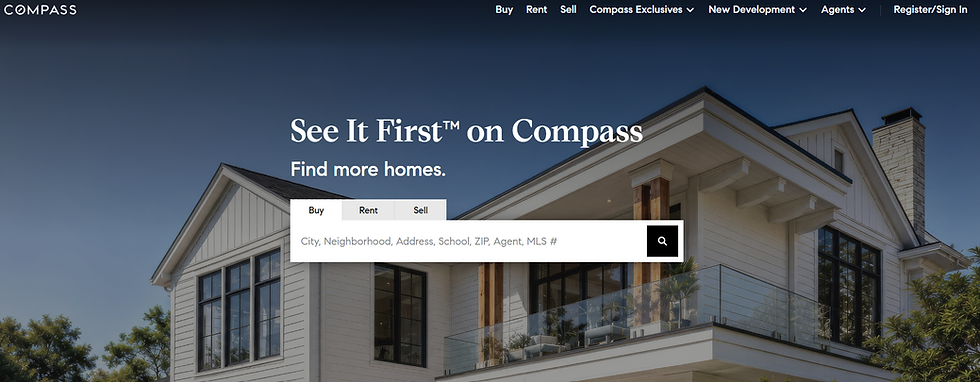
Compass blends brokerage and technology, and its website reflects that. The experience feels polished and editorial, with large imagery, curated collections, and tools that let clients save, organize, and share homes with partners, family, or their agent.
Standout features: Collections for saving and sharing, strong visuals, and agent-connected search.
Design lesson: House hunting is a team sport. Add sharing and collaboration tools, so decisions move faster.
5. Rightmove: best for consistent, easy-to-compare listings

Rightmove is the UK's best-known property portal, and its strength is clarity. Listings follow a consistent layout with photos, floor plans, virtual tours and key facts that are easy to scan. Buyers know exactly where to look, and that familiarity builds trust.
Standout features: Consistent listing layout, floor plans, virtual tour links, and map search.
Design lesson: Consistency beats cleverness. A predictable property page makes comparison easy.
6. StreetEasy: best for hyperlocal market depth

StreetEasy shows how a portal can win by going deep on one market. Centered on New York City, it focuses on the details that urban renters and buyers care about, such as neighborhoods, building information, floor plans, and tours.
Standout features: Neighborhood focus, building-level detail, floor plans, and tour support.
Design lesson: Local depth is a competitive advantage. Neighborhood pages and building guides also help with local SEO.
7. Sotheby's International Realty: best luxury real estate website design

When it comes to luxury real estate website design, Sotheby's International Realty is a go-to example. The look is closer to a glossy magazine than a database, with cinematic photography, generous white space, and a global search that feels like browsing a collection.
Standout features: Editorial layouts, large imagery, video and tour content, and global property search.
Design lesson: For high-end properties, atmosphere sells. Let the visuals breathe and keep the interface quiet.
8. CREXi: best commercial real estate website design

CREXi shows what strong commercial real estate website design looks like. Investors and tenants need data, so the platform pairs high-quality images and virtual tours with detailed property information, making it easier to judge a space before visiting.
Standout features: Detailed listing data, imagery and virtual tours, and commercial-focused search.
Design lesson: Serious buyers want facts fast. Put key numbers and documents right where they are looking.
9. Realtor.com best for MLS-backed accuracy

Realtor.com earns its place with reliability. Its listings are closely tied to MLS data, which supports trust, and it has long been known for featuring tours from providers like Matterport in its listing experience. The design keeps search, photos, and contact options simple.
Standout features: MLS-backed listings, tour integration, and straightforward search and contact flow.
Design lesson: Accuracy is a design feature. Fresh, correct listing data builds confidence.
10. homes.com: Best for neighborhood context

Homes.com rounds out the list with a neighborhood-first approach. Along with listings, it gives buyers context about the areas around a home, because people are not just buying a house; they are buying a lifestyle. Like several major portals, it has also featured Matterport tours.
Standout features: Neighborhood content, listing search, and tour support.
Design lesson: Pair every property with its surroundings. Schools, commutes, and local life help buyers say yes.
Best real estate websites compared
Website | Best for | Standout feature | Lesson to borrow |
Zillow | Residential search at scale | 3D Home tours | Make immersive content easy to create |
Matterport | Virtual tours on any site | Dollhouse view | Make the tour a hero element |
Redfin | Pre-qualifying buyers | 3D Walkthrough | Use tours as a filter |
Compass | Collaborative buying | Shared collections | Add sharing tools |
Rightmove | UK property search | Consistent listing pages | Predictable layouts build trust |
StreetEasy | City markets | Building-level detail | Go local |
Sotheby's International Realty | Luxury homes | Editorial design | Let visuals lead |
CREXi | Commercial property | Detailed listing data | Surface data quickly |
Realtor.com | Listing accuracy | MLS-backed data | Keep data accurate |
Homes.com | Neighborhood research | Area context | Sell the area, not just the home |
How to Apply These Ideas to Your Own Property Website
You do not need a portal-sized budget to borrow the best ideas. Whether you are building website design for real estate agents, a brokerage site, or a developer showcase, start here:
Make virtual tours impossible to miss. Place the tour above the fold on every listing page. Add a 3D virtual tour or at least a 360 view for your top properties.
Add interactive floor plans. Buyers love understanding flow and room sizes before they visit. It also reduces wasted showings.
Build search that rivals the portals. Offer filters, map view, saved searches and one-tap favorites.
Design for the thumb. Test every page on a phone first. Keep buttons large and forms short.
Be fast. Compress images, lazy-load galleries, and test page speed regularly.
Own your local story. Create neighborhood pages, market updates and local guides. Real estate is local, and your content should be too.
Capture leads at the right moment. Use clear calls to action such as "Book a viewing" and "Get the floor plan," and connect forms to your CRM.
Quick tip: Use portals for reach, then send traffic to your own website, where you control the brand and the conversation. That is where leads turn into clients.
Final Thoughts
The best real estate websites share one idea: they respect the buyer's time. They show more, explain faster, and make the next step obvious. Add immersive tours, smart search, and a mobile-first build, and your website stops being a brochure and starts behaving like your hardest-working agent.
Planning a property portal or agency website? Talk to Pravaah Consulting about a mobile-first real estate website with virtual tours and smart search
Questions? Answers.
1. What makes a real estate website design the best in 2026?
The best real estate website designs in 2026 combine fast mobile-first performance, powerful search filters with map views, immersive virtual tours, interactive floor plans and clear calls to action. They load quickly, make property details easy to scan and guide visitors toward booking a viewing or contacting an agent.
2. Do virtual tours really help property listings get more leads?
Yes. Zillow has reported that listings with a 3D Home tour earn significantly more online views, and industry reports link virtual tours to higher engagement and better-qualified inquiries. Tours let buyers screen a home remotely, so the people who book a viewing are usually more serious.
3. What features should an interactive property portal have?
An interactive property portal should include advanced search filters, a map and list view, saved searches and favorites, high-resolution photos, 3D or 360 virtual tours, interactive floor plans, mortgage or rent calculators, neighborhood information and instant contact or booking options. It should also work smoothly on smartphones.
4. What is the difference between a 3D virtual tour and a 360 tour?
A 360 tour lets viewers look around from fixed points inside a property, while a 3D virtual tour (such as a Matterport scan) builds a spatial model that viewers can walk through and often view from above in a dollhouse view. 3D tours usually feel more immersive, and 360 tours are often faster and cheaper to create.
5. How much does it cost to add virtual tours to a real estate website?
Costs vary by property size, tour type, and provider. Some portals, such as Zillow, let agents create 3D tours for free with a smartphone, while professional scanning services are often quoted in the low hundreds of dollars per property. Website development costs depend on features, integrations, and the number of listings.
6. How can a real estate website rank on Google and in AI answers?
To rank on Google and in AI answers, use local keywords in property and neighborhood pages, add schema markup, keep pages fast on mobile, publish clear question-and-answer content, and keep listings accurate and fresh. Original market insights and well-structured pages make it easier for search engines and AI tools to cite your site.


