
What is a Minimum Viable Product (MVP)? A Complete Guide to Starting Lean

Key Takeaways
|
You have a brilliant product idea. You've spent weeks, maybe months, thinking it through, sketching wireframes, debating features with your team, and imagining the day it launches to a standing ovation from the market. And then reality hits: where do you actually begin?
This is where the concept of the minimum viable product becomes essential. Whether you're a startup founder trying to get your first product off the ground or a product leader at an established company looking to validate a new direction, understanding what an MVP is and how to build one can be the difference between smart product development and a very expensive mistake. Let's break it all down!
What Is a Minimum Viable Product (MVP)?

A minimum viable product is the simplest, most stripped-down version of your product that still delivers real value to its first users and, above all else, allows your team to gather meaningful feedback with minimal effort and investment.
The term was popularized by Eric Ries in his landmark book The Lean Startup. He described it as "the version of a new product that allows a team to collect the maximum amount of validated learning about customers with the least effort."
In other words, an MVP is about building something focused. It's not the smallest product you can get away with; it's the smallest product that actually teaches you something real. So what does MVP mean in practical terms? It means resisting the urge to build every feature you've imagined and instead identifying the one core problem you're solving, the one primary user you're solving it for, and the minimum set of capabilities needed to solve it well enough to learn from.
What Does MVP Mean in Business?
In a business context, the MVP meaning goes beyond product development; it's a philosophy of smart, risk-aware growth. When you ask what an MVP in business is, the answer is really about de-risking your biggest assumptions before you commit serious time, money, and energy to them.
Think about it this way: every product is built on a stack of assumptions. You assume that people have a certain problem. You assume they'll pay to have it solved. You assume your proposed solution is the right one. An MVP is the tool you use to stress-test those assumptions against the real world before they cost you everything.
This is why MVPs have become foundational in modern product strategy, from seed-stage startups to Fortune 500 companies launching new product lines. The stakes of being wrong are simply too high to skip this step.
Why Build an MVP? The Core Benefits
It Dramatically Reduces Risk: The biggest reason teams build MVPs is to avoid the most painful outcome in product development: spending months building something nobody wants. An MVP surfaces that reality early, when it's still affordable to pivot.
It Accelerates Time to Market: A full-featured product takes time. An MVP, by design, does not. Getting to market faster means you start learning from real users sooner, which in turn lets you improve sooner. In fast-moving markets, that speed advantage compounds quickly.
It Generates Real, Actionable Data: Surveys and focus groups are useful, but nothing beats watching real people actually use or struggle to use your product. An MVP gives you that data. Not guesses, not projections. Real behavior.
It Attracts Early Investors and Stakeholders: Investors don't fund PowerPoint decks; they fund validated momentum. Showing that real users have engaged with your MVP, even in its simplest form, is far more compelling than the most polished pitch deck.
It Keeps Teams Focused: Without the discipline of an MVP, product teams tend to keep adding features. An MVP enforces ruthless prioritization, which is a healthy practice to build into your team's culture from day one.
MVP in Software Development: A Special Case
In the world of software MVPs, the concept is particularly powerful yet tricky to execute well. Software teams face a constant gravitational pull toward feature bloat: the temptation to add "just one more thing" before launch.
A well-defined software minimum viable product pushes back against that pull. It asks the team to agree, upfront, on the smallest possible set of functionality that constitutes a working, valuable product. This is about learning architecture. The features you choose for your software MVPs should be the ones that will teach you the most about whether your core value proposition resonates.
For MVPs in software specifically, this often involves:
Landing pages to test demand before a single line of code is written
Manual workflows ("Wizard of Oz" MVPs) where humans simulate automated functions
Single-feature apps that do one thing exceptionally well
API-first prototypes that prove technical feasibility without a polished front end
The goal is always the same: learn fast, spend little, iterate.
How Agile Methodology Powers MVP Development
The relationship between an agile MVP and agile methodology is deep and mutually reinforcing. In many ways, the MVP is the ultimate expression of agile thinking applied to the product level.
Agile methodology is built around iterative development, continuous feedback, and adaptive planning. It rejects the waterfall model (where you define everything upfront and build it all before showing anything to users) in favor of short sprints, working software, and regular retrospectives.
An agile MVP applies this same logic to product strategy. Instead of defining the full product vision and then building toward it in a single long arc, agile teams use the MVP as their first sprint to learn. They ship something small, get feedback, update their understanding, and repeat the process.
In practice, building an MVP in an agile environment typically looks like this:
The product backlog is stripped to only the features required for the MVP
The team works in sprints (usually 1–2 weeks) toward the MVP release
Each sprint produces a testable, potentially shippable increment
User feedback from MVP testers feeds directly into backlog refinement
The product roadmap evolves based on what's actually learned, not what was assumed
This approach, sometimes called agile MVP development, is how companies like Spotify, Airbnb, and Dropbox built their first products, and it's the approach Pravaah Consulting brings to every product engagement.
Famous MVP Examples: What They Got Right
Understanding what MVP means becomes much clearer when you look at how iconic companies actually used the approach.
1. Amazon: The Online Bookstore
In the mid-1990s, Jeff Bezos wanted to build the world's biggest online store. But he didn't start there. He identified books as the easiest category to test his e-commerce hypothesis; they were standardized, easy to ship, and had a large addressable market. He ran a bare-bones online bookstore from his garage, validated the demand, and only then began expanding. The rest, as they say, is history. Amazon started as a minimum viable product for e-commerce, not as the everything store it became.
2. Uber: The SMS Cab Service
Before there was a slick mobile app with surge pricing algorithms and driver ratings, there was UberCab, an iPhone-only SMS service in San Francisco that let you text for a cab. Founders Travis Kalanick and Garrett Camp identified a clear pain point (difficulty hailing a cab at night or in bad weather), built the most minimal possible solution, and tested it locally. That SMS service was the MVP that proved the concept and secured the venture capital needed to build the app.
3. Spotify: The Landing Page
In 2006, streaming music services were struggling. Poor-quality libraries, high prices, unstable playback. Daniel Ek and Martin Lorentzon built Spotify's MVP as a simple landing page that streamed music to a small group of beta users with ads to cover licensing costs. Their goal was to prove that fast, stable streaming was technically and commercially viable. Once proven, they expanded into the platform that now hosts over 600 million users globally.
How to Build a Minimum Viable Product: A Step-by-Step Guide
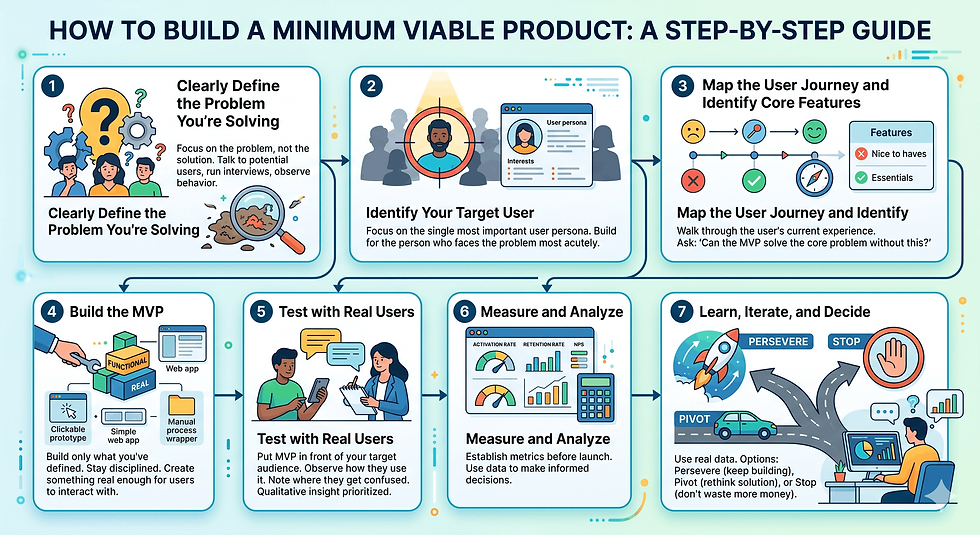
Step 1: Clearly Define the Problem You're Solving
Everything starts with the problem, not the solution. Before a single wireframe is drawn or a line of code is written, you need to be ruthlessly clear about what specific problem you're solving, for whom, and why existing solutions fall short. Talk to potential users. Run interviews. Observe behavior in the wild. Your MVP will only be as good as your understanding of the problem it solves.
Step 2: Identify Your Target User
An MVP designed for "everyone" serves no one. Narrow your focus to the single most important user persona, the person who faces this problem most acutely and is most likely to engage with even an imperfect solution. Building for a specific user makes every subsequent design and prioritization decision easier.
Step 3: Map the User Journey and Identify Core Features
Walk through your target user's end-to-end experience. What steps do they take to solve this problem today? Where does that journey break down? Map out the ideal journey with your solution, and identify only the features essential to completing it. Everything else is a "nice to have" that doesn't belong in the MVP.
A useful test: for every proposed feature, ask "Can the MVP solve the core problem without this?" If the answer is yes, cut it.
Step 4: Build the MVP
Please build now, but only what you've defined. This is often the hardest step, because it requires resisting the natural instinct to add more. Stay disciplined. Your MVP needs to be real enough for users to interact with and learn from.
Depending on your product type, this might mean a clickable prototype, a functional web app with limited features, a manual process wrapped in a simple UI, or even a landing page.
Step 5: Test with Real Users
Put the MVP in front of real people from your target audience, the actual users you built it for. Observe how they use it. Note where they get confused. Ask what they value and what they wish were different. Prioritize qualitative insight over quantitative metrics at this stage.
Step 6: Measure and Analyze
Establish metrics before you launch the MVP, so you know what success looks like. Common MVP metrics include activation rate, retention rate, task completion rate, and Net Promoter Score (NPS). These numbers, combined with qualitative feedback, give you the data you need to make informed decisions about what to build next.
Step 7: Learn, Iterate, and Decide
Now you have real data. Use it. Based on what you've learned, you have three basic options: persevere (the MVP is working; keep building in the same direction), pivot (the core insight is right but the solution needs rethinking), or stop (the problem isn't as acute as you thought, or your solution isn't the right one).
All three outcomes are valid. The worst outcome is spending more money building something the market doesn't want.
MVP vs. PoC vs. Prototype: Understanding the Differences
These three terms are often used interchangeably, but they mean different things and serve different purposes.
A Proof of Concept (PoC) answers the question, "Can this be built?" It's typically an internal, technical exercise designed to test feasibility. A PoC is never shown to end users.
Prototype answers the question, "How should this look and feel?" A prototype is a visual or interactive mockup used to test design assumptions and gather UX feedback. It may not be functional in any meaningful way.
A Minimum Viable Product (MVP) answers the question, "Will people actually want and use this?" It's a functional product released to real users to validate the business hypothesis.
Understanding which tool is right for your current question will save you significant time and money.
Feature | Proof of Concept (PoC) | Prototype | Minimum Viable Product (MVP) |
|---|---|---|---|
Core Question | "Can this be built?" | "How will it look and feel?" | "Will users actually pay for/use this?" |
Primary Goal | To verify technical feasibility or a specific concept. | To test design, layout, and user flow (UX). | To validate market demand and collect user feedback. |
Target Audience | Internal stakeholders and developers. | Stakeholders and a small group of beta testers. | Real early adopters and the live market. |
Functionality | Minimal; often just a "skeleton" of a single feature. | Interactive but "hollow" (no real backend/database). | Fully functional core features that solve a real problem. |
Lifecycle Stage | Pre-development (The "Idea" phase). | Design phase (The "Visual" phase). | Launch phase (The "Market" phase). |
Outcome | A "Go/No-Go" technical decision. | A refined design and UI/UX roadmap. | A validated product ready for iterative scaling. |
Common MVP Mistakes to Avoid
Even experienced product teams fall into these traps:
Building too much: The most common mistake. If your MVP has 15 features, it's not an MVP. Get brutal about scope.
Skipping the "viable" part: An MVP must still deliver real value. A product so stripped down that it can't actually solve the user's problem won't generate useful feedback; it'll just generate confusion.
Not defining success metrics upfront: If you don't know what you're measuring before you launch, you won't know what the results mean afterward.
Testing with the wrong users: Your co-founders are not your users. Neither is your developer community (unless that's literally your target market). Test with the people you actually built it for.
Treating the MVP as the final product: An MVP is a hypothesis test, not a finished product. Build it to learn from it, not to defend it.
How Pravaah Consulting Helps You Build Smarter MVPs
At Pravaah Consulting, we've helped startups and enterprise teams across healthcare, e-commerce, logistics, and manufacturing go from product idea to validated MVP fast. Our product engineering teams are built around agile methodology, which means we build learning loops.
Whether you're exploring a new vertical SaaS platform, a custom internal tool, or a customer-facing digital product, we bring the strategic clarity and engineering depth needed to define, build, and iterate on MVPs that generate real insight.
We believe the best products in the world were built by teams who were willing to start small, learn fast, and build with discipline. That's the MVP mindset. And it's the approach we bring to every project.
FAQs
1. What is an MVP in software development?
In software development, an MVP (Minimum Viable Product) is a version of a product with just enough features to satisfy early customers and provide feedback for future development. It focuses on the core functionality required to solve a specific problem.
2. How does an agile MVP differ from a prototype?
A prototype is a draft used to test design or technical concepts internally, often not functional for end-users. An agile MVP, however, is a functional, launched version of the product that provides real value to users and allows for data collection in a live market.
3. What is an MVP product example?
Many famous companies started as MVPs. For example, Airbnb began as a simple website offering air mattresses in the founders' apartment during a conference. They didn't build a global booking engine first; they validated the "minimum" idea of people staying with strangers.
4. Why is the minimum viable product important for startups?
The MVP is vital because it prevents startups from building products that nobody wants. By focusing on a software minimum viable product, founders can conserve capital, test their business assumptions, and iterate based on real user behavior.
5. What are the key elements of a successful MVP?
A successful MVP must be functional, reliable, usable, and have a clear design. While it is "minimum," it must still provide a high-quality user experience for the specific problem it intends to solve.
6. How do I know when my MVP is ready to launch?
Your MVP is ready when it successfully completes the "User Journey" for your primary target audience and solves their main pain point. If adding more features doesn't change the core value proposition, it’s time to launch and start learning.
Author
Pritesh Sonu is a technology entrepreneur and the CEO of Pravaah Consulting, where he leads AI-driven digital transformation for forward-thinking enterprises. With over 20 years of experience at firms such as Infosys and Accenture, Pritesh also co-founded Octopus SaaS, a platform that modernizes medical waste operations. An alumnus of IIT Dhanbad and Indiana University’s Kelley School of Business, he specializes in bridging the gap between complex technology and strategic business value.


